

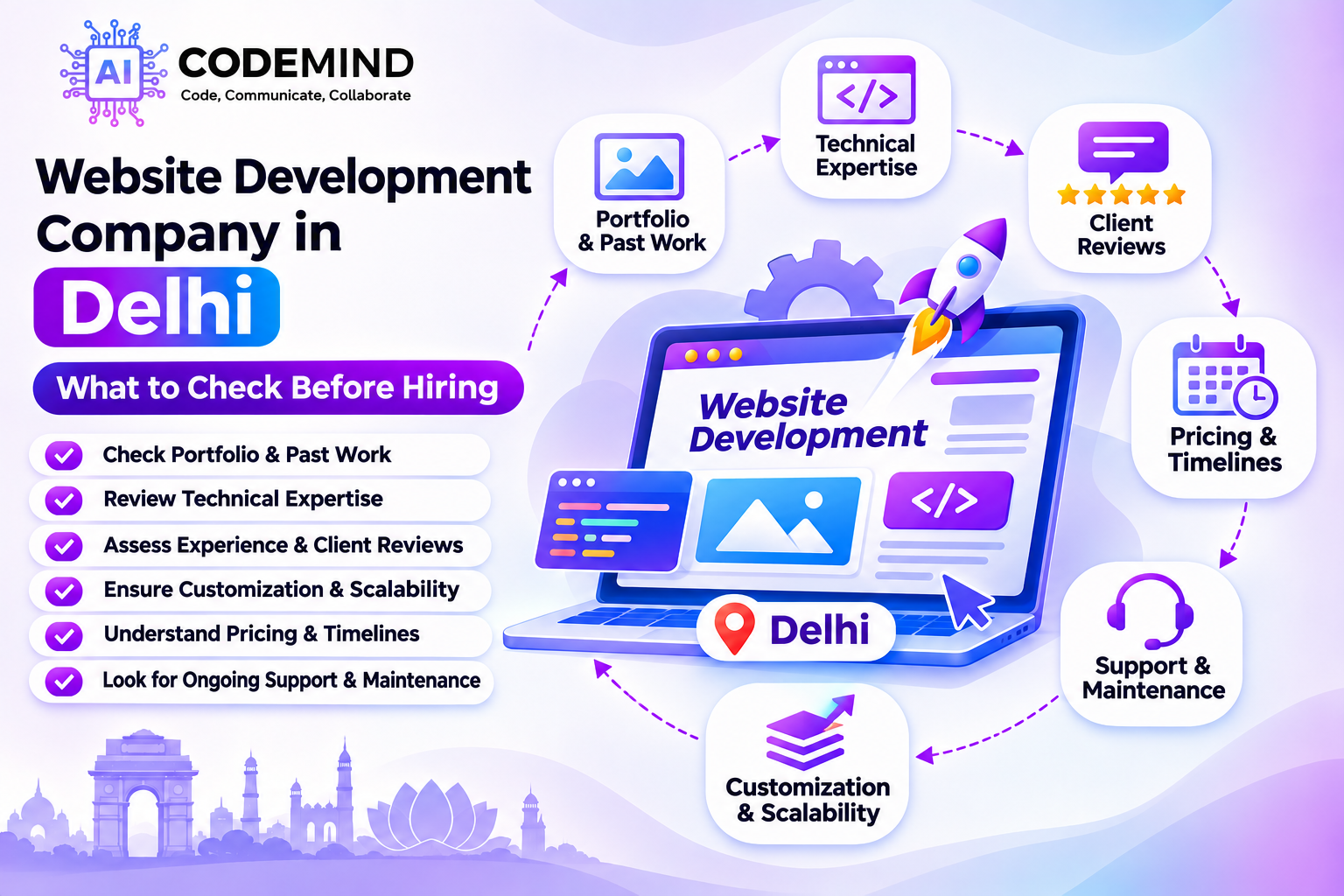
Website Development Company in Delhi: What to Check Before Hiring
Hiring a website development company in Delhi is an important decision for businesses looking to attract customers and improve online visibility. A website must do more than look professional: it should work reliably, be easy to maintain and support customer acquisition. This guide from Ai Codemind explains what to check before hiring a web development agency in Delhi NCR.
Table of Contents
- What should you check before hiring a website development company in Delhi?
- 1. Define your website requirements and business goals
- 2. Review the agency portfolio and relevant experience
- 3. Evaluate technical expertise and platform selection
- 4. Check responsive design and user experience
- 5. Ensure the website is built with SEO foundations
- 6. Review website security, performance and scalability
- 7. Compare website development costs in Delhi
- 8. Confirm website ownership and handover terms
- 9. Understand the development process and delivery timeline
- 10. Check maintenance and post-launch support
- 11. Evaluate total cost and potential business return
- 12. Compare website development companies using a scorecard
- 13. Warning signs to avoid before hiring
- 14. How Ai Codemind can help your business
- Frequently Asked Questions
- Conclusion
- Related Website Development and SEO Services
What should you check before hiring a website development company in Delhi?
Check the agency’s relevant portfolio, technical approach, written scope, SEO foundations, security, ownership terms, testing process and post-launch support. Compare the total cost of running the website, not just the initial development quote. A suitable partner should explain how the website will support your business goals and how success will be measured.
Whether you operate in Delhi, Noida, Gurugram, Ghaziabad or Faridabad, choose a partner based on demonstrable capability rather than proximity alone. Start by discussing your requirements with a professional website development company.
1. Define your website requirements and business goals
Before requesting quotations, document your target customers, key services, desired actions and existing business processes. A local service provider may need enquiry forms and location pages; a retailer needs product management, payments and order workflows. A B2B company may need detailed service pages and CRM integration.
| Business type | Website priority | Success metric |
|---|---|---|
| Local business | Mobile service pages and contact options | Qualified calls and enquiries |
| B2B company | Service details, case studies and CRM | Qualified sales opportunities |
| Ecommerce | Product discovery, checkout and inventory | Completed orders and contribution |
| Enterprise | Integrations, access controls and workflows | Task completion and reliability |
Prepare a list of essential features and a separate list of optional enhancements. This prevents scope creep and allows competing proposals to be compared fairly.
2. Review the agency portfolio and relevant experience
Ask for live examples of projects similar to yours, not just attractive screenshots. Test the navigation, mobile layout, forms and checkout where appropriate. Ask which parts the agency actually delivered, whether it built the backend, and how the project was maintained after launch.
Review the Ai Codemind portfolio and request relevant examples or references during your consultation. Do not assume that a visually attractive site is fast, secure or successful at generating enquiries. Ask for verifiable outcomes and permission-based client references.
3. Evaluate technical expertise and platform selection
A reliable web development agency should recommend a platform based on your requirements, team skills, integrations and maintenance budget rather than a preferred technology alone.
| Platform or approach | Suitable use | What to verify |
|---|---|---|
| WordPress development | Content-led business sites | Plugin maintenance, editor access and backups |
| Laravel development | Custom portals and business workflows | Architecture, tests and deployment documentation |
| Shopify development | Hosted ecommerce stores | Subscription, app fees and checkout constraints |
| WooCommerce development | WordPress-based ecommerce | Hosting, plugin compatibility and updates |
| Custom web application development | Specialized integrations and processes | API design, permissions and scalability |
Ask who will maintain the code, how updates are tested and whether the proposed platform can support future features. For custom development, request documentation and a clear handover process.
4. Check responsive design and user experience
A website should help visitors complete their intended tasks with minimal friction. Review the proposed page layouts, navigation, typography, mobile menus, contact forms and calls to action. Request wireframes or prototypes before development begins.
Professional UI/UX design services should consider accessibility, keyboard navigation, readable contrast, meaningful form labels and clear error messages. Test on real mobile devices, not only a desktop browser resized to a narrow window.
For lead generation, make contact options easy to find and ask only for information necessary to qualify an enquiry. For ecommerce, show delivery terms and total costs clearly before payment.
5. Ensure the website is built with SEO foundations
SEO-friendly development begins before launch. Ask how the agency will manage page URLs, crawlable navigation, title tags, canonical tags, XML sitemaps, redirects and indexability. Important content should be accessible to search engines and users.
| SEO requirement | Acceptance check |
|---|---|
| Crawlability | Important pages are reachable through normal links |
| Metadata | Unique editable titles and descriptions |
| Indexing | Correct robots directives and canonical URLs |
| Migration | Old URLs mapped to relevant new URLs with redirects |
| Structured data | Accurate supported markup matching visible content |
| Performance | Mobile testing and Core Web Vitals review |
Coordinate technical SEO services and on page SEO services with development. Google recommends helpful content and accessible pages; a technically sound website does not guarantee rankings. Review the official Google SEO Starter Guide for the underlying principles.
6. Review website security, performance and scalability
Ask how the agency handles HTTPS, dependency updates, input validation, access permissions, backups and restoration testing. Administrative accounts should use strong authentication and least-privilege access. Sensitive information must not be exposed in public files or logs.
For ecommerce, clarify payment gateway integration and avoid unnecessary storage of payment card information. Request a plan for privacy notices, data retention and secure handling of customer enquiries.
Performance testing should include representative pages and devices. Ask how images, caching, database queries and third-party scripts will be managed. A scalable architecture should reflect expected demand rather than expensive infrastructure without a clear need.
7. Compare website development costs in Delhi
Website development cost depends on scope, design complexity, integrations, content migration and testing. The following are illustrative planning budgets, not surveyed Delhi market rates or official Ai Codemind quotations.
| Project scenario | Illustrative build budget | Scope example |
|---|---|---|
| Basic business website | ₹25,000–₹60,000 | Limited pages, contact form and editable content |
| Custom corporate website | ₹60,000–₹1,50,000 | Custom layouts, CMS and selected integrations |
| Ecommerce website | ₹75,000–₹2,50,000 | Catalog, checkout and order management |
| Custom web application | ₹1,50,000+ | Business workflows, roles and integrations |
Request itemized estimates for design, development, content, testing, hosting, licenses and maintenance. Complex requirements can exceed these scenarios. A low initial quote may exclude important functionality or ongoing costs. Ask for a written change-request process before signing.
8. Confirm website ownership and handover terms
Your contract should clearly identify who owns the domain, hosting account, source code, design files and content. Register business-critical accounts under your organization where practical and grant the agency appropriate access. Third-party software and stock assets may have separate license restrictions.
| Asset | What to confirm |
|---|---|
| Domain and hosting | Business-controlled accounts and renewal access |
| Source code | Repository access and agreed intellectual property rights |
| CMS and database | Administrator access and export procedure |
| Analytics and Search Console | Business ownership and agency permissions |
| Design and licenses | Editable files and permitted usage |
| Handover | Documentation, backups and deployment instructions |
Confirm exit terms and whether another developer can maintain the site. Ownership should be addressed in writing, not assumed from payment alone.
9. Understand the development process and delivery timeline
| Stage | Deliverable | Approval |
|---|---|---|
| Discovery | Requirements and scope | Business owner |
| Design | Wireframes and page designs | Design sign-off |
| Development | Working staging website | Feature review |
| Testing | Defect fixes and acceptance tests | User acceptance |
| Launch | Deployment and tracking checks | Launch approval |
| Support | Handover and maintenance plan | Operational review |
A simple website and a custom application have different delivery timelines. Ask for milestone dates, dependencies and who supplies content or approves designs. Review a staging site before launch and define acceptance criteria for each essential feature.
10. Check maintenance and post-launch support
A website requires ongoing updates, monitoring and occasional improvements. Ask whether the agency includes a defect warranty and what counts as new work. Confirm support hours, response targets, backup frequency, restoration procedures and renewal costs.
Consider website maintenance services if your team lacks technical capacity. For a redesign, coordinate website redesign services with an SEO migration plan to protect existing useful URLs and tracking.
11. Evaluate total cost and potential business return
Compare the first-year cost of ownership and the potential contribution from new customers. The following hypothetical example illustrates the calculation, not a promised outcome.
| First-year cost item | Example |
|---|---|
| Development | ₹80,000 |
| Hosting and licenses | ₹12,000 |
| Maintenance | ₹36,000 |
| Total first-year cost | ₹1,28,000 |
| Contribution per additional customer | ₹8,000 |
| Additional customers to cover cost | 16 |
If the website produces 24 incremental customers with ₹8,000 contribution each after direct costs, the contribution is ₹1,92,000. Subtracting the ₹1,28,000 website cost gives ₹64,000 before other marketing expenses, overhead and taxes. The illustrative return is 50%. Track qualified enquiries, completed sales and attribution rather than assuming all website visitors become customers.
12. Compare website development companies using a scorecard
Rate each proposal from 1 to 5 on the following criteria. Multiply the rating by its weight and divide by five. The sum gives a score out of 100. Use the result to guide discussions, not replace reference checks.
| Criterion | Weight | Evidence to request |
|---|---|---|
| Relevant portfolio | 20% | Live projects and references |
| Technical expertise | 25% | Architecture and implementation plan |
| SEO, UX and security | 20% | Acceptance checklist |
| Pricing and ownership | 20% | Itemized proposal and contract |
| Support and communication | 15% | Handover and support terms |
13. Warning signs to avoid before hiring
Be cautious of vague proposals, guaranteed Google rankings, missing ownership terms, no staging environment, unclear maintenance charges and requests to pay the full amount without agreed milestones. Avoid agencies that cannot explain their technical choices or provide a realistic testing plan.
Ask how changes are approved, how defects are handled and who will communicate project progress. A professional website development company should be willing to clarify exclusions and dependencies before development starts.
14. How Ai Codemind can help your business
Ai Codemind offers website development services, custom website development, ecommerce website development and business website development. Businesses can discuss their requirements alongside SEO services and digital marketing services to plan a website that supports customer acquisition.
To request a relevant proposal, share your current website, target audience, essential features, preferred launch timeline and budget. Request a customized website development quotation to discuss scope and actual pricing.
Frequently Asked Questions
How do I choose the best website development company in Delhi?
Compare relevant live projects, technical expertise, written scope, ownership, testing and maintenance terms. Choose the agency that fits your requirements rather than relying on ranking claims.
How much does website development cost in Delhi?
Costs depend on scope and integrations. A basic website might be modeled at ₹25,000–₹60,000 for planning, but this is not a verified market rate or official quotation.
How long does it take to develop a business website?
A limited business site may take several weeks; custom projects can take months. Content readiness, approvals and integrations affect the timeline.
Which platform is best for a business website?
WordPress, Laravel, Shopify and other platforms suit different requirements. Evaluate editing needs, integrations, hosting and long-term maintenance.
Will an SEO-friendly website guarantee Google rankings?
No. Technical SEO supports search eligibility and usability, but rankings also depend on content, competition and search engine decisions.
Who should own the domain and source code?
The business should control its domain and critical accounts. Source code and design ownership must be explicitly agreed in the contract, subject to third-party licenses.
Is website maintenance necessary after launch?
Yes. Updates, backups, monitoring and security reviews help maintain reliability. Agree on support scope and costs before launch.
Does Ai Codemind provide website development and SEO services?
Ai Codemind offers website development, ecommerce, Laravel, WordPress and SEO services. Contact the team to discuss your specific project.
Conclusion
Choosing a website development company in Delhi requires more than comparing prices. Evaluate technical expertise, user experience, SEO foundations, security, ownership and ongoing support. A well-planned website should support measurable business goals and remain manageable after launch.
Contact Ai Codemind to discuss a website development strategy tailored to your business.
EXPLORE OUR CAPABILITIES
Related Website Development and SEO Services
Website Development Services ↗Custom Website Development ↗Business Website Development ↗Ecommerce Website Development ↗Laravel Development ↗WordPress Development ↗Shopify Development ↗WooCommerce Development ↗Website Redesign Services ↗UI/UX Design Services ↗Website Maintenance Services ↗Custom Web Application Development ↗SEO Services ↗Technical SEO Services ↗Digital Marketing Services ↗Conversion Rate Optimization ↗