

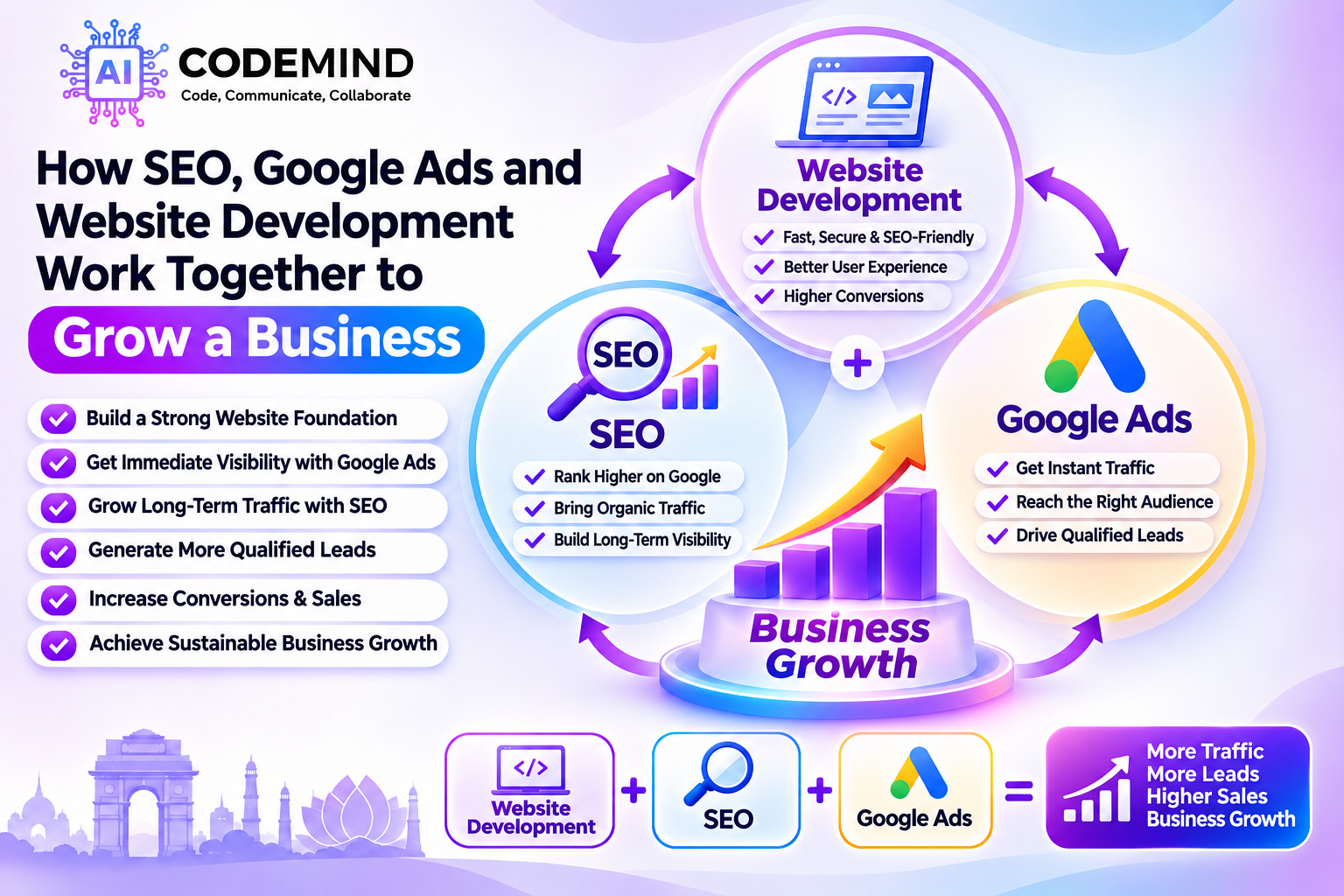
How SEO, Google Ads and Website Development Work Together to Grow a Business
Growing a business online requires more than traffic. A coordinated strategy connects search visibility, targeted advertising and a website that helps customers take action. This guide from Ai Codemind explains how to combine these investments and measure their business impact.
Table of Contents
- How do SEO, Google Ads and website development work together?
- 1. How SEO supports sustainable business growth
- 2. How Google Ads generates targeted business opportunities
- 3. Why professional website development is the foundation
- 4. How the three services support the customer journey
- 5. How SEO and Google Ads share useful insights
- 6. Build conversion-focused landing pages
- 7. Integrated digital marketing budget: illustrative example
- 8. Measure qualified leads and marketing ROI
- 9. Track performance across SEO, advertising and the website
- 10. A 90-day integrated growth roadmap
- 11. Choose the right strategy for your business type
- 12. Common mistakes that reduce digital marketing returns
- 13. How Ai Codemind can help your business
- Frequently Asked Questions
- Conclusion
- Related SEO, Google Ads and Website Development Services
How do SEO, Google Ads and website development work together?
SEO attracts relevant organic visitors, Google Ads reaches potential customers through paid campaigns, and a professionally developed website turns that attention into enquiries or sales. Together they form a customer acquisition system rather than three disconnected services. A business can use advertising to test demand while building organic visibility and improving the website for both channels.
| Channel | Role | Business outcome |
|---|---|---|
| SEO Services | Build organic search visibility | Relevant unpaid visits |
| Google Ads Services | Reach customers through paid campaigns | Measurable paid enquiries |
| Website Development Services | Provide a fast, usable conversion destination | More effective customer journeys |
1. How SEO supports sustainable business growth
Search engine optimization helps customers discover your services when they research a problem, compare suppliers or look for a nearby business. A professional SEO company should prioritize relevant demand rather than simply chasing high-volume keywords. Start by mapping customer questions to service pages and useful articles, then address technical barriers to crawling and indexing.
Local SEO Services can help eligible businesses reach customers in their service area, while Technical SEO Services address site architecture, redirects and indexing. On Page SEO Services improve page relevance and internal navigation. Original content and earned references can support discovery over time.
Organic traffic is not free to produce: research, development, writing and maintenance require investment. Rankings and timelines are never guaranteed.
2. How Google Ads generates targeted business opportunities
Google Ads lets businesses test offers and reach people searching for relevant products or services. Search campaigns can focus on commercial queries, while other campaign types may suit product discovery or broader awareness. Start with a defined audience, location, budget and conversion goal.
Use search term reports, negative keywords and relevant landing pages to reduce wasted spend. A PPC Management Services engagement should include conversion measurement, budget reviews and campaign refinement. Advertising can begin generating visits soon after approval, but enquiries and sales depend on demand, competition, offers and the website experience.
Paying for Google Ads does not directly improve organic rankings. The value of combining channels comes from shared insights and better customer journeys, not a paid ranking advantage.
3. Why professional website development is the foundation
A website is where customers evaluate your business and decide whether to contact you. A slow, confusing or unreliable site can waste both paid and organic traffic. A professional website development company should plan navigation, mobile usability, accessibility, security and clear conversion paths from the beginning.
Business Website Development should include relevant service pages, contact options, trustworthy company information and a manageable content system. For complex workflows, Custom Web Application Development may be appropriate. Ecommerce businesses need reliable product information, checkout and payment integration.
| Website requirement | Why it matters |
|---|---|
| Mobile-friendly design | Customers can browse and enquire on smaller screens |
| Fast loading and stable layout | Reduces avoidable friction |
| Clear service pages and calls to action | Helps visitors understand the offer |
| Secure forms and reliable hosting | Protects customer information and availability |
| Search-friendly architecture | Supports discovery and maintenance |
| Analytics and consent controls | Supports responsible measurement |
4. How the three services support the customer journey
Customers rarely follow a single linear path. Someone may discover a business through an organic article, return through a paid search ad and submit an enquiry after reviewing a service page. Build consistent messaging across touchpoints and make the next action clear.
| Stage | Marketing activity | Website requirement |
|---|---|---|
| Discovery | SEO articles and relevant ads | Helpful content |
| Consideration | Service pages and targeted campaigns | Portfolio, FAQs and evidence |
| Decision | High-intent search campaigns and organic service pages | Clear offer and enquiry form |
| Follow-up | CRM and sales communication | Reliable lead capture |
5. How SEO and Google Ads share useful insights
Paid search term data can reveal the language customers use and which offers attract qualified enquiries. Use these findings to prioritize organic content, while checking whether the topic has lasting relevance. Organic search data can also reveal pages and questions worth testing in paid campaigns.
Keep reporting separate by channel, then examine combined business outcomes. Avoid treating paid clicks as organic ranking signals or adding together duplicate conversions. Use consistent campaign tagging and reconcile enquiry records with the CRM.
6. Build conversion-focused landing pages
Match each campaign to a page that answers the visitor’s intent. A customer searching for ecommerce development should reach a relevant ecommerce page, not a generic homepage. Explain the scope, process, genuine proof and next step. Keep forms short enough for the purpose and test whether submissions actually reach the sales team.
Landing Page Design and Conversion Rate Optimization can improve the experience for paid and organic visitors. Test one meaningful change at a time where traffic allows, and measure qualified enquiries rather than button clicks alone.
7. Integrated digital marketing budget: illustrative example
Allocate investment according to the current website condition, customer demand and available resources. A new website may require foundation work before campaigns scale. An established site may need only targeted improvements. The following is a hypothetical monthly budget, not an official quotation or market average.
| Investment | Monthly amount |
|---|---|
| SEO and content | ₹20,000 |
| Google Ads media spend | ₹30,000 |
| PPC management | ₹10,000 |
| Website improvements and tracking | ₹10,000 |
| Total before taxes | ₹70,000 |
Initial website development, hosting, software, creative production and applicable taxes may be additional. Confirm inclusions before signing a contract.
8. Measure qualified leads and marketing ROI
Suppose the combined ₹70,000 monthly investment generates 80 unique valid enquiries, of which 40 qualify and eight become customers. Assume each customer contributes ₹12,000 after direct delivery costs. This is a hypothetical example, not a client case study or forecast.
| Metric | Calculation | Result |
|---|---|---|
| Cost per valid enquiry | 70,000 / 80 | ₹875 |
| Cost per qualified lead | 70,000 / 40 | ₹1,750 |
| Customer acquisition cost | 70,000 / 8 | ₹8,750 |
| Customer contribution | 8 × 12,000 | ₹96,000 |
| Net contribution after marketing | 96,000 − 70,000 | ₹26,000 |
| Marketing ROI | 26,000 / 70,000 × 100 | 37.1% |
Track incremental customers attributable to marketing where possible. Account for sales delays, refunds, overhead and other costs before interpreting profitability. Do not count the same customer twice when both channels contributed.
9. Track performance across SEO, advertising and the website
Use Google Search Console for organic search performance, Google Ads reporting for paid campaigns and analytics for website actions. Connect these records to sales outcomes with appropriate privacy controls. Marketing Analytics Services can help establish consistent definitions and reporting.
| Area | Useful metrics |
|---|---|
| SEO | Relevant organic clicks, indexed pages, qualified organic leads |
| Google Ads | Spend, conversion rate, cost per qualified lead |
| Website | Form completion, checkout completion, usability issues |
| Sales | Qualified leads, customers, contribution and acquisition cost |
Review attribution settings and test conversion events before relying on reports. A form submission is not necessarily a qualified lead or sale.
10. A 90-day integrated growth roadmap
Coordinate development, SEO and paid media around shared priorities. The following roadmap describes implementation milestones rather than guaranteed results.
| Period | Priority | Deliverables |
|---|---|---|
| Days 1–30 | Audit and foundations | Website review, keyword mapping, tracking tests, campaign plan |
| Days 31–60 | Launch and improve | Priority fixes, landing pages, initial campaigns, content improvements |
| Days 61–90 | Evaluate and refine | Lead quality review, budget adjustments, content expansion, conversion tests |
11. Choose the right strategy for your business type
Different businesses require different channel mixes. Begin with a focused offer and expand only when measurement and delivery capacity support it.
| Business type | SEO focus | Ads and website focus |
|---|---|---|
| Local service business | Location and service pages | Local search ads, calls and enquiries |
| Ecommerce | Product and category content | Shopping campaigns and checkout |
| B2B company | Industry-specific expertise | High-intent search ads and qualified lead forms |
| Startup | Foundational pages and useful content | Offer testing and flexible landing pages |
12. Common mistakes that reduce digital marketing returns
- Launching paid campaigns before checking forms and conversion tracking.
- Building a website without planning search intent and mobile usability.
- Sending every ad to the homepage.
- Buying manipulative backlinks or accepting guaranteed rankings.
- Optimizing for traffic instead of qualified customers.
- Allowing teams to work independently without shared reporting.
- Scaling advertising before confirming lead quality and sales capacity.
13. How Ai Codemind can help your business
Ai Codemind brings together SEO Services, Google Ads Services and Website Development Services within a coordinated digital marketing strategy. Businesses can discuss technical improvements, content priorities, paid campaigns and conversion measurement as part of a tailored scope.
Whether you need a new website or improvements to an existing one, begin with your business objectives, target locations, current performance and available budget. Request a customized consultation to discuss suitable deliverables and investment.
Frequently Asked Questions
Can SEO and Google Ads work together?
Yes. They reach customers through different search channels and can share keyword, offer and conversion insights.
Does Google Ads improve SEO rankings?
No. Advertising spend does not directly improve organic rankings.
Should I develop my website before running ads?
Ensure the destination is functional, relevant and measurable before spending. A complete redesign is not always necessary.
Which is better for small businesses: SEO or Google Ads?
It depends on demand, budget and timing. SEO builds organic visibility over time; ads can test demand sooner.
How much should I budget for all three services?
Request a scope-based quotation. The ₹70,000 monthly example in this article is illustrative and excludes applicable taxes and initial development.
How long does an integrated strategy take?
Implementation can begin in weeks, but organic growth and reliable sales measurement may take months. No fixed results are guaranteed.
How can I measure combined marketing results?
Track unique qualified leads and customers, reconcile channel reports with CRM data and compare contribution with total costs.
Does Ai Codemind offer all three services?
Ai Codemind offers SEO, Google Ads and website development services. Contact the team to discuss a coordinated plan.
Conclusion
SEO, Google Ads and website development work best when they support the same customer acquisition goals. Build a reliable website, attract relevant visitors through organic and paid search, and use qualified leads and customer contribution to guide investment. Contact Ai Codemind to discuss a coordinated growth strategy.
EXPLORE OUR CAPABILITIES
Related SEO, Google Ads and Website Development Services
SEO Services ↗Google Ads Services ↗Website Development Services ↗Digital Marketing Services ↗Local SEO Services ↗Technical SEO Services ↗On Page SEO Services ↗AI Search Optimization ↗PPC Management Services ↗Google Search Ads ↗Business Website Development ↗Ecommerce Website Development ↗Landing Page Design ↗Conversion Rate Optimization ↗Lead Generation Services ↗Marketing Analytics Services ↗